
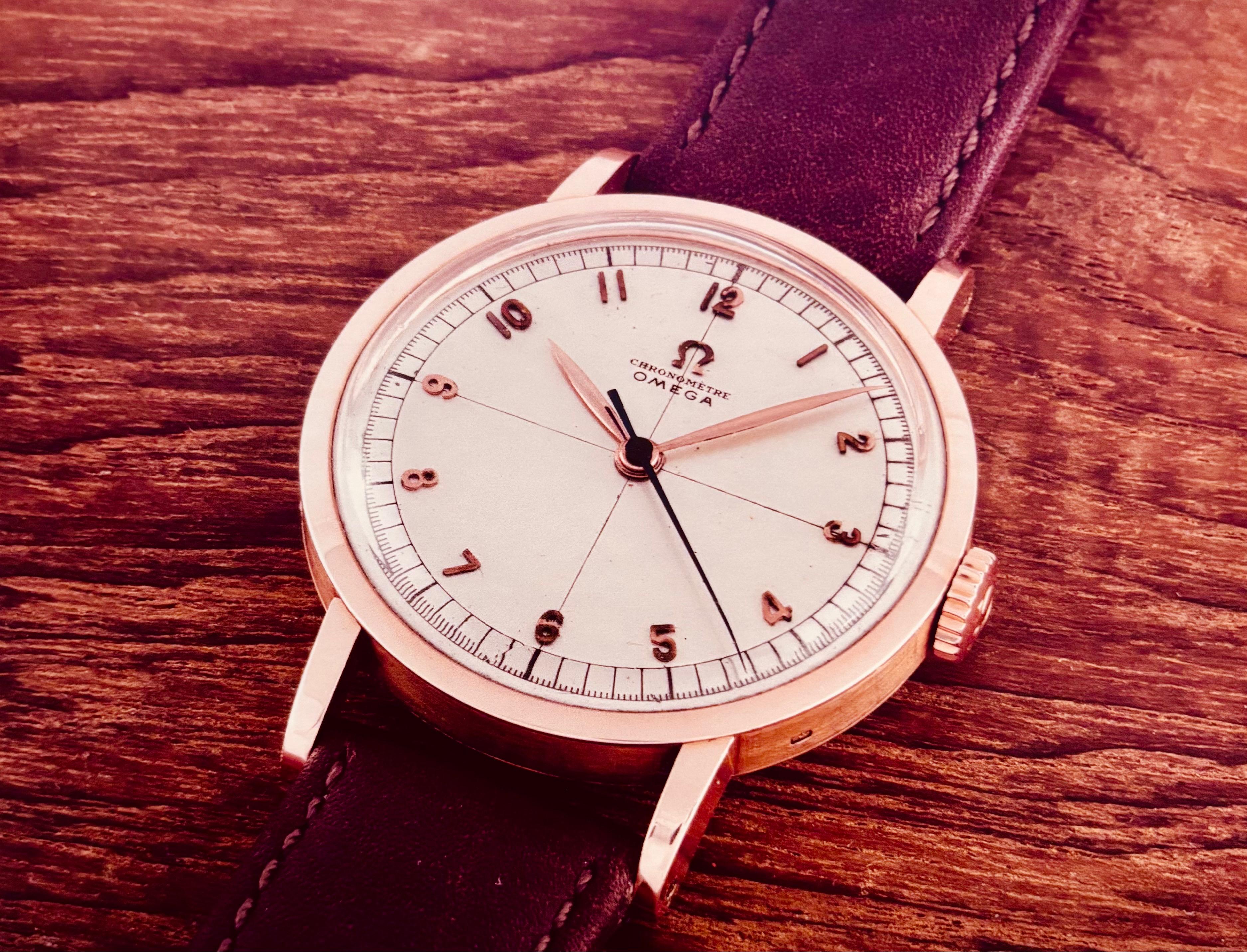


There’s a particular kind of vintage watch that doesn’t announce itself with bulk, hype, or a waiting list. It simply arrives—perfectly proportioned, quietly precious—and then refuses to leave your mind. The Omega Chronomètre reference 2367 in 18k pink gold is that kind of piece: centre seconds, a crisp two‑tone dial, applied pink‑gold Arabic numerals, and a movement so respected that collectors talk about it the way music lovers talk about an original pressing.

If you’ve spent years circling the obvious icons, this is the moment you take a different exit. Not toward louder watches, but toward better ones—watches built for accuracy when accuracy still meant something, and built with taste when “taste” was not a hashtag. The 2367 sits in that sweet spot: dressy but not delicate, refined but not timid, and, in 1948 pink gold, unmistakably special.
Omega’s post‑war years were a masterclass in doing the fundamentals at an elite level. The brand wasn’t just selling glamour; it was selling confidence in engineering—timing competitions, precision regulation, and chronometer‑grade finishing that could stand next to far more expensive names without blinking. The ref. 2367 “Chronomètre” is part of that story. It’s a watch from an era when the word Chronomètre carried weight, when it meant this movement had been tuned and judged, not merely marketed.
The example in your images hits all the collector pressure points. The case is 18k pink gold, warm and flattering—less bright than yellow gold, more human than white metal. The dial is two‑tone silvered, which sounds simple until you see it in the flesh: a subtle shift in texture and shade that gives the face dimension without resorting to gimmicks. Then come the details that make it feel like a piece of jewelry designed by engineers: those applied pink‑gold Arabic numerals, the needle‑fine minute track, and the clean, confident centre seconds hand that adds just enough motion to keep the dial alive.
Even the size feels right. At 36 mm, it’s not trying to play modern games, but it wears beautifully—especially because the proportions are so balanced. There’s space on the dial, air around the numerals, and a slim elegance that reads “considered,” not “small.” In 2026, when many collectors are rediscovering mid‑century sizes and realizing how comfortable they are, the 2367 lands like an inside joke shared among people who’ve tried everything else.
Now, the heart of the matter: the calibre. This reference is powered by Omega’s manual 30 T2 SC RG—one of those movements that has a reputation beyond its spec sheet. Collectors love it because it’s not only precise, but also beautifully executed: copper‑toned, cleanly laid out, and finished with that “deluxe” feel that makes you want to open the caseback just to admire the architecture. It’s a movement with a serious purpose—chronometer timekeeping—yet it’s also a movement that understands aesthetics. The result is a watch that feels like a connoisseur’s purchase even before you consider the gold.
The centre seconds detail is worth lingering on. Many mid‑century dress watches use small seconds, which can look charming but also very “period.” Centre seconds brings a more modern energy. It feels sportier, more dynamic—like the watch is built to keep up with your life rather than simply accompany your outfit. That subtle modernity is why a 1948 Omega like this can look surprisingly current on the wrist, even next to contemporary minimal watches.

So who is this for? It’s for the collector who wants quality over noise. The person who’s comfortable wearing pink gold without making it a personality trait. The person who appreciates that the best flex is often the one only a few people will recognize. In New York or London, it pairs effortlessly with soft tailoring and loafers. In Tokyo or Seoul, it reads as sharp and intentional—an old watch with clean lines that match modern wardrobes. In Dubai, Riyadh, or Tel Aviv, pink gold feels culturally fluent: luxurious, yes, but also tasteful—more glow than glare.
The impression it gives is unmistakable: calm authority. This is not a watch that screams “I collect.” It says, “I know.” It’s the kind of piece that works in intimate settings where people notice details—a dinner, a gallery opening, a hotel bar with dim lighting. It also shines (quietly) at life events: weddings, engagements, anniversaries, promotions—moments where you want something meaningful that doesn’t feel like a costume.
If you’re thinking about daily wear, the 2367 is practical in an old‑school way. It’s manual wind, so you’ll wind it—gently, once a day—and that becomes part of the charm. The crystal listed is plastic, which is more forgiving than people assume; it can pick up hairline marks, but it also polishes nicely and keeps that warm vintage distortion at the edges. And while it’s not a “sports” watch, it’s a solid mid‑century dress watch that can handle real life if you treat it with basic respect.
From a collecting strategy standpoint, this reference also sits at a fascinating intersection of value and quality. Your attached page shows an estimate of CHF 3,000–5,000 (and USD 3,100–5,100; EUR 2,800–4,700), which reads like a time when the market hadn’t fully priced in how desirable these chronometer Omegas would become. In 2026, the conversation is different. The best examples—especially in precious metal, with strong dials and archive extracts—have gained real momentum. Not “viral hype” momentum, but the slow, steady kind that serious collectors trust.
And that’s why it’s also a smart watch to research. There are enough examples out there to compare, but not so many that it feels generic. Condition matters hugely: the sharpness of the case, the cleanliness of the dial printing, the integrity of the applied numerals, and the quality of the movement. Archive documentation is a cherry on top, and your page notes an Omega Extract from the Archives—exactly the kind of detail that makes a collector feel comfortable paying for correctness, not just for the look.
If you’re the type who enjoys shopping vintage thoughtfully—reading descriptions, checking serial ranges, asking the boring questions that protect you from expensive regret—this is where a good “price reference for vintage watch” mindset pays off. And yes, there’s still joy in the chase: finding the right patina, the right case shape, the right dial tone that fits your taste. The 2367 rewards that patience.
One more thing: this watch photographs beautifully. Pink gold and silvered two‑tone dials play well in natural light; the applied numerals catch highlights; the seconds hand gives the dial a sense of life. If you’re someone who enjoys documenting your collection—wrist shots in cafés, travel snaps, a quiet “watch and book” moment—this Omega has that effortless editorial quality. It looks expensive even when you’re not trying.
In the end, the Omega Chronomètre ref. 2367 is a reminder that the best vintage isn’t always the loudest vintage. Sometimes it’s the watch that sits slightly outside the mainstream—still historically important, still mechanically special, but worn by people who prefer elegance with substance. In five years, it will still look right. In ten, it will look even better. That’s the entire point.
Table: Specifications & 2026 Market Estimate
| Specification | Details |
|---|---|
| Manufacturer | Omega |
| Year | 1948 |
| Reference no. | 2367 |
| Movement no. | 10,662,566 |
| Case no. | 10,810,486 |
| Model name | Chronomètre |
| Material | 18k pink gold |
| Crystal | Plastic |
| Calibre | Manual, 30 T2 SC RG |
| Seconds | Centre seconds |
| Bracelet/strap | Leather |
| Clasp/buckle | Plated buckle |
| Dimensions | 36 mm diameter |
| Signed | Movement, dial, and case signed |
| Accessories | Accompanied by Omega Extract from the Archives |
| Estimate shown (catalogue) | CHF 3,000–5,000; USD 3,100–5,100; EUR 2,800–4,700 |
| Inflation‑adjusted 2026 equivalent (from USD estimate only) | Approximately USD 11,500–18,900 (inflation adjustment, not a sale prediction) |
| Practical 2026 market expectation | Often USD 9,000–25,000+ depending on dial originality, case condition, archive extract, and overall “sharpness”; exceptional examples can exceed this |


Leave a Reply