
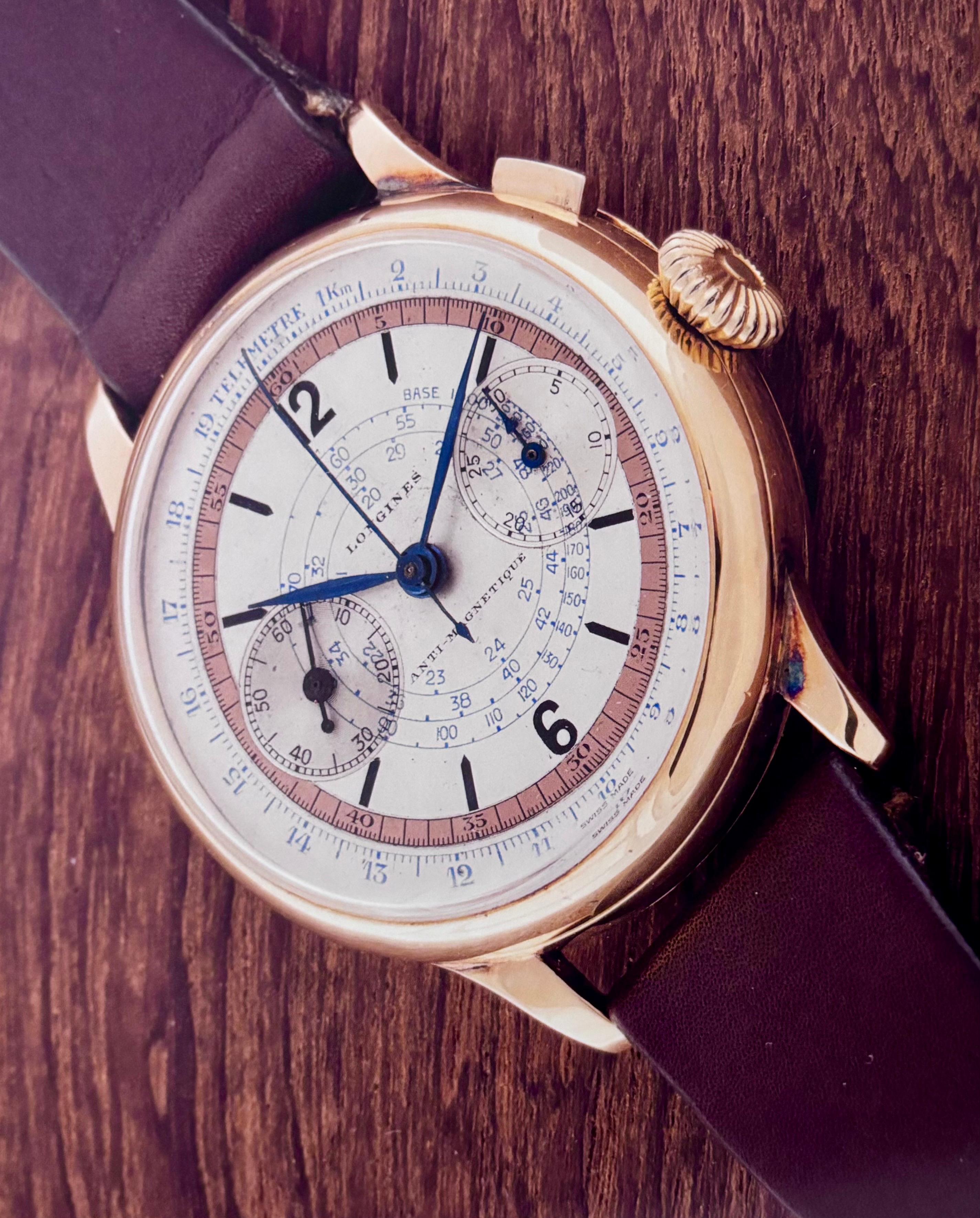


Some vintage watches charm you slowly. This one hits fast. A large 18k yellow‑gold Longines single‑button chronograph from 1935—two‑tone dial, blue scales, hinged caseback—doesn’t just look rare; it looks deliberate, like it was designed for someone who needed precision in public and discretion in private. It’s the kind of pre‑war piece that feels almost too modern to be nearly a century old, yet too romantic to belong to our era.

There’s a reason collectors get a little animated about early Longines chronographs. The brand wasn’t simply participating in the chronograph race—it was shaping it, with movements that were genuinely serious and cases that were often made to be used, not just admired. When you add a mono‑pusher layout (one button to start, stop, reset), a generous 40 mm diameter, and a hinged case that opens like a secret compartment, you’re in a very specific corner of vintage: the place where engineering and elegance share the same address.
This 1935 example is especially compelling because it plays with contrast the way great tailoring does. The warm glow of yellow gold meets a dial that’s busy in the best way—telemeter and tachymeter scales printed in blue, a two‑tone sector‑style layout with rose‑toned accents, and registers that feel like instruments rather than decoration. Put it on a simple leather strap and it becomes the ultimate flex for people who don’t flex.
Pre‑war chronographs were born in an age when measuring time could be a matter of work, sport, or survival. Before cockpit computers and digital dashboards, timing was tactile. You pressed a pusher and you committed. Mono‑pusher chronographs, in particular, have a distinct rhythm: start, stop, reset—always in order. That limitation is exactly what makes them charming. They don’t encourage you to overthink. They ask you to be present.
Longines built some of the most desirable early chronograph movements for wristwatches, and by the 1930s the brand had serious credibility with doctors, engineers, and sportsmen. The watch in your images lists a manual “15’’’” movement, which places it in the lineage of Longines’ respected hand‑wound chronograph calibres of the era—large, stable, and designed to deliver dependable timing. The finishing, even in utilitarian examples, tends to be surprisingly pretty: bridges with warm tones, crisp edges, and that unmistakable old‑world “made to last” vibe.

The hinged case is another detail that instantly separates this watch from the pack. In the 1930s, hinged casebacks weren’t just a styling flourish—they were practical. They made access easier for service, and they created a satisfying sense of protection. There’s something luxurious about a case that opens with intention, like a compact mirror or a cigarette case from the same decade. It feels intimate, even a little cinematic—especially when the inside back carries period engravings and hallmarks that prove the watch has lived a real life.
And then we get to the dial—the reason you’d spot this piece from across a room full of high‑end steel sports watches. The two‑tone execution gives depth, the blue printing adds a cool, technical edge, and the whole layout reads like a dashboard from a golden‑era Italian car. The mix of scales is very 1930s: telemeter for measuring distance by sound (think thunder, artillery, or even trackside starts), tachymeter for speed over a known distance. It’s old science on the wrist, and it still works today. No updates needed.
Size matters here too. A 40 mm case in 1935 wasn’t normal—it was bold. That’s why the watch feels so current when you wear it now. It doesn’t sit on the wrist like a delicate antique; it has presence. In yellow gold, that presence becomes warmth rather than flash. You get the glow, not the glare.
So who is this watch for? Not the person chasing a predictable “top ten” list. This is for someone with a collector’s eye—someone who likes the idea of owning a watch that most people will never recognize, yet serious enthusiasts will respect instantly. It’s also a power move for anyone who’s tired of the modern cycle of hype and release dates. Wearing a pre‑war Longines chronograph says you’re not shopping trends—you’re collecting chapters.
The impression it gives is wonderfully specific. On one hand, it reads as cultured: a vintage gold watch with real design intelligence. On the other, it reads as capable: a timing instrument with a no‑nonsense dial. That duality makes it incredibly versatile. It works with a linen suit on a summer evening in Europe, a black knit and trousers in Seoul, a crisp white shirt in Dubai, or even a relaxed weekend look in Tokyo where the watch becomes the only “formal” thing you need.
Occasion-wise, this is not a gym watch, and it doesn’t want to be. But it’s perfect for moments where taste matters: gallery openings, business dinners, weddings, or any setting where you want to look put‑together without looking like you tried. It’s also a brilliant travel watch in a very analog sense—no second time zone, no worldtime city ring, just a reminder that real luxury is having time to spare.
From a market angle, early Longines chronographs have been quietly gaining heat as collectors broaden their horizons beyond the obvious names. The best ones combine three things: size, dial quality, and documented originality. Your attached page notes that this watch comes with a Longines Extract from the Archives, which is the kind of paperwork collectors love because it anchors the story in something official. For rare pre‑war watches, that matters more than people think.
Now, about the 2026 price context. The estimate shown in the picture is CHF 15,000–25,000 (and USD 15,400–25,600; EUR 14,200–23,700), which looks like an auction estimate from the time the catalogue was printed. Adjusted for inflation into 2026 purchasing power, the equivalent numbers rise sharply—yet the real market can swing even further depending on condition, case integrity, dial originality, and how “right” the watch feels in hand. Pre‑war gold chronographs are a collector’s market: two watches with the same headline specs can sell at wildly different prices because one has the magic and the other doesn’t.
If you’re trying to buy intelligently, focus on the non‑negotiables: original dial printing, case lines that haven’t been over‑polished, a chronograph mechanism that snaps cleanly through its sequence, and documentation that matches the watch. In that sense, this piece isn’t just an “antique watch” in the casual meaning of the term—it’s a functional artifact with strong design, strong mechanics, and strong presence.
If you’re the kind of collector who enjoys a good rabbit hole, this is also where the fun begins. Early Longines chronographs reward research: movement numbers, case numbers, delivery countries, dial variations, and the subtle evolution of scale layouts. And if you like reading old auction catalogues the way some people read magazines—this watch is exactly the sort of watch that makes that hobby feel justified. For anyone building a “vintage watches catalogue” mindset, a mono‑pusher Longines like this is a cornerstone piece.
And yes—this is the sort of watch that makes people ask, quietly, “What is that?” Not because it’s flashy, but because it’s unusual. The answer is never short. It turns into a conversation about pre‑war design, the romance of hinged cases, and a time when measuring speed and distance on your wrist felt like the height of modernity.
Table: Specifications & 2026 Market Estimate
| Specification | Details |
|---|---|
| Manufacturer | Longines |
| Year | 1935 |
| Movement no. | 5’259’723 |
| Case no. | 5’259’723 |
| Material | 18k yellow gold |
| Crystal | Plastic |
| Calibre | Manual, 15’’’ |
| Chronograph control | Single button (mono‑pusher) |
| Bracelet/strap | Leather |
| Clasp/buckle | Gold plated, signed Longines |
| Dimensions | 40 mm diameter |
| Signed | Case, dial and movement signed |
| Accessories | Accompanied by Longines Extract from the Archives |
| Estimate shown (catalogue) | CHF 15,000–25,000; USD 15,400–25,600; EUR 14,200–23,700 |
| Inflation‑adjusted 2026 equivalent (from USD estimate only) | Approximately USD 57,000–95,000 (inflation adjustment, not a sale prediction) |
| Practical 2026 market expectation | Often USD 45,000–120,000+ depending on dial originality, case condition, provenance, and how rare the exact configuration is; exceptional examples can exceed this |


Leave a Reply