
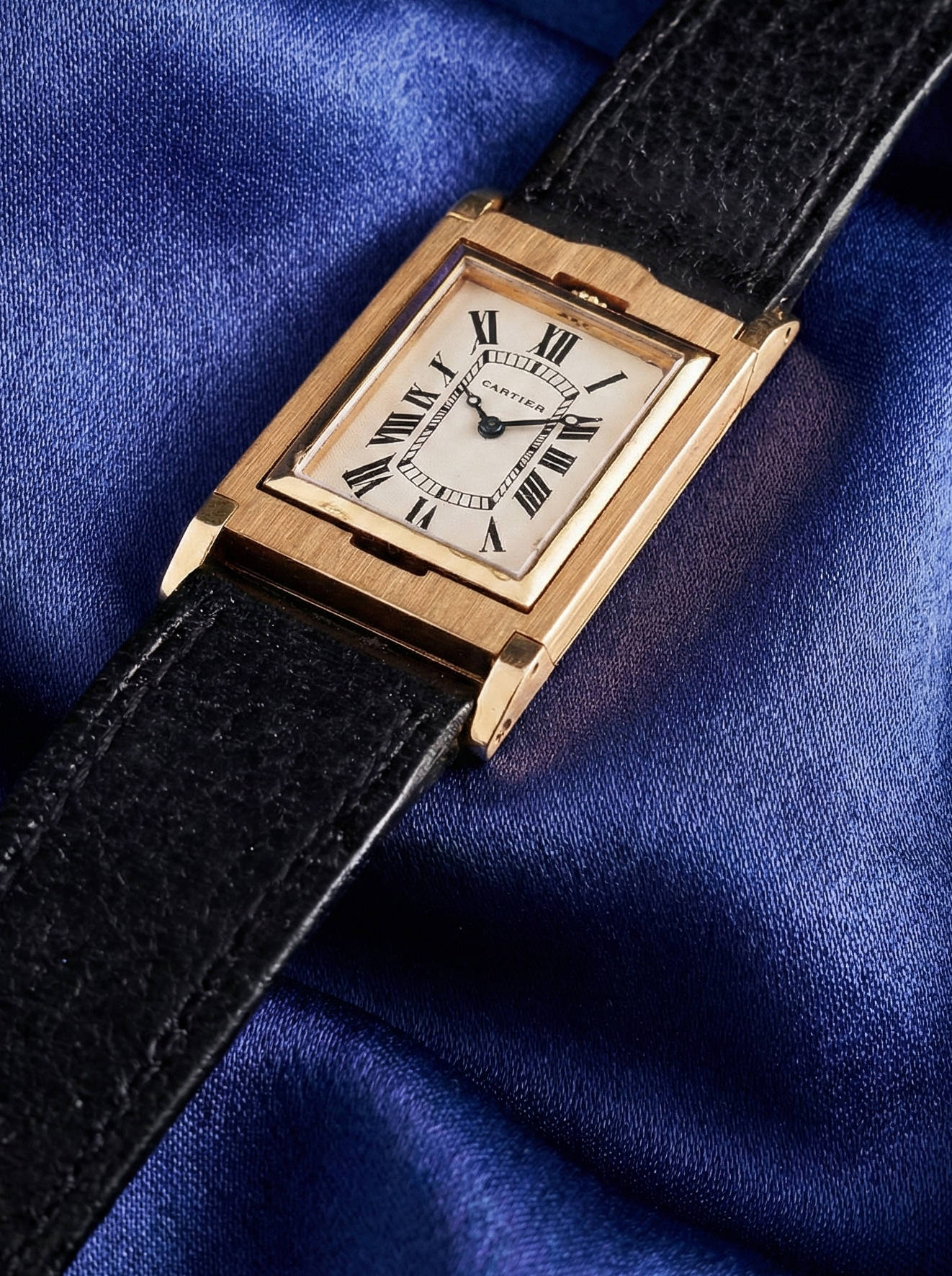


Some watches are loud about their status. Others are quiet, even shy—until you touch them. The 1964 Cartier montre bracelet réversible basculante is the second kind: a discreet yellow‑gold rectangle with Roman numerals and a crown parked at 12 o’clock like a wink, hiding its best trick in plain sight. One motion and the case pivots, flipping the dial away from danger and presenting a solid gold back that feels like a personal shield. If you’ve ever wanted a vintage Cartier that lives somewhere between jewelry, engineering, and a private club password, this is it.

In a world trained to worship complications, the Basculante’s appeal is more poetic than technical. It’s not a perpetual calendar or a split‑seconds chronograph. It’s a concept—protection, discretion, transformation—wrapped in 18k yellow gold. And that concept has aged brilliantly. Today, when “stealth wealth” is a mood and quiet luxury is practically a dress code, a reversible Cartier from the 1960s reads like an insider’s choice.
Cartier introduced the basculante idea in the early 1930s, an answer to a very specific social problem: active lifestyles were rising among the well‑dressed, and delicate crystals didn’t love polo, tennis, or even a rough evening out. The solution was clever. Instead of building a thicker case, Cartier created a case that could pivot within a frame around a central axis—so the dial could be turned inward when you wanted to protect it. That’s why the crown sits at 12. It’s not a quirky design flourish. It’s logic.
By 1964, the Basculante had evolved into something especially compelling: larger, more assertive proportions, and an unmistakably mid‑century presence. The example in your images is a rare yellow‑gold reversible wristwatch with a strong, architectural case and classic Cartier dial codes—Roman numerals, chemin de fer minute track, and blued hands. It’s the kind of watch that makes modern rectangular dress watches feel a bit too polite.
The real charm is in how it wears. Rectangular watches can be either timid or theatrical; the Basculante lands right in the sweet spot. The case has heft without being bulky, and its lines are crisp enough to feel modern, even now. In gold, it doesn’t scream—it glows. Pair it with a black leather strap and it looks like a vintage Cartier should: slightly formal, a little cinematic, and effortlessly “put together” without trying too hard.
Then comes the flip. If you’ve never handled a basculante, it’s hard to explain the sensation. It’s tactile. Mechanical. Satisfying in the same way closing the door of a well‑built classic car is satisfying. You’re not tapping a screen; you’re engaging with an object that was designed to move. In an era where so many luxury items are static and precious, the Basculante invites you to use it.
There’s also an emotional layer to that reversible back. On many reversible watches, the blank back becomes a canvas: initials, a date, a private message, a family crest. It’s a quiet tradition—engraving as a form of intimacy. Even unengraved, a clean gold back feels like a statement: this watch isn’t begging for attention. It’s keeping its best side for the owner.
From a collecting standpoint, vintage Cartier sits in a fascinating place right now. The market has matured beyond the obvious icons, and collectors have started chasing the deeper cuts: unusual case shapes, rare mechanisms, niche references that speak to taste rather than trends. The Basculante belongs in that conversation, especially examples from the 1960s with bolder dimensions. This is the kind of piece that watches people will clock immediately, but the broader room probably won’t—and that’s exactly the point.
What should you look for if you’re hunting one? First, proportions. Many early basculantes are smaller, very charming but undeniably “period.” The 1960s pieces often wear more confidently, which is why they’ve become so desirable. Second, dial condition. Cartier dials can be fragile—patina is normal, heavy damage is not. You want the Roman numerals to remain crisp, the minute track intact, and the signature balanced. Third, the mechanics of the flip: it should feel firm and secure, not loose or sloppy. This is a moving case, and how it moves matters.

And then there’s the movement. This 1964 example is listed with a manual movement (a thin hand‑wound calibre), which suits the watch perfectly. A manual Cartier is a daily ritual: a few careful turns each morning, the sense of setting your day in motion. It’s quiet, intimate, and very on‑brand for a watch that’s already built around personal interaction.
Style-wise, the Basculante is a cheat code. It looks correct with tailoring, but it also elevates casual outfits in a way sports watches often can’t. Worn with denim and a white tee, it reads as intentional. Worn with a blazer, it reads as cultured. Worn with black at night, it looks like you borrowed it from a film character with impeccable taste and questionable habits. And because it’s Cartier, it carries that signature blend of Parisian elegance and practical design—an object that feels equally at home in a vintage jewelry box or on a modern collector’s wrist in 2026.
Now, about value. Your attached page shows an estimate in the CHF 30,000–40,000 range and USD 30,700–41,000 (with a listed year of 1964 and full specs), which reads like a period auction estimate for that particular lot. In 2026 money, that historical USD estimate is dramatically higher when adjusted for decades of inflation—and that’s before you add the modern collector premium for rarity, Cartier heat, and condition. Put simply: this is not just a “nice vintage Cartier.” It’s a rare mechanism in precious metal, from a golden era, with a design that has never stopped looking good.
What makes it truly timeless is that the Basculante is less about being seen and more about being lived with. It is a dress watch that doesn’t fear real life. It can take a bump because it can hide its face. It can go from dial‑out to dial‑in in a second. It’s a watch that understands that elegance isn’t fragility—it’s control.
If you’re building a vintage‑leaning collection today, the Basculante offers something a Sub or a Daytona never will: intimacy. A small mechanical moment you perform for yourself, not for anyone else. In five years, ten years, twenty years, that’s the kind of luxury that still feels fresh.
Table: Specifications & 2026 Market Estimate
| Specification | Details |
|---|---|
| Manufacturer | Cartier |
| Year | 1964 |
| Model name | Montre bracelet réversible basculante |
| Case number | 46’247 |
| Material | 18k yellow gold |
| Crystal | Glass |
| Movement | Manual, “6’’’” (hand‑wound) |
| Bracelet/strap | Leather |
| Clasp/buckle | 18k gold, Cartier buckle |
| Dimensions | 42 mm length; 23 mm width |
| Signed | Case and movement signed European Watch and Clock; dial signed Cartier; case stamped with hand‑stamped numbers on outside and inside revolving case |
| Estimate shown (period) | CHF 30,000–40,000; USD 30,700–41,000; EUR 28,400–37,900 |
| Inflation‑adjusted 2026 equivalent (from the USD estimate only) | Approximately USD 300,900–401,800 (inflation adjustment, not a sale prediction) |
| Practical 2026 market expectation (collector reality) | Often anywhere from USD 120,000–300,000+ depending on condition, originality, provenance, and how rare the exact 1960s variant is; exceptional examples can push beyond |


Leave a Reply