
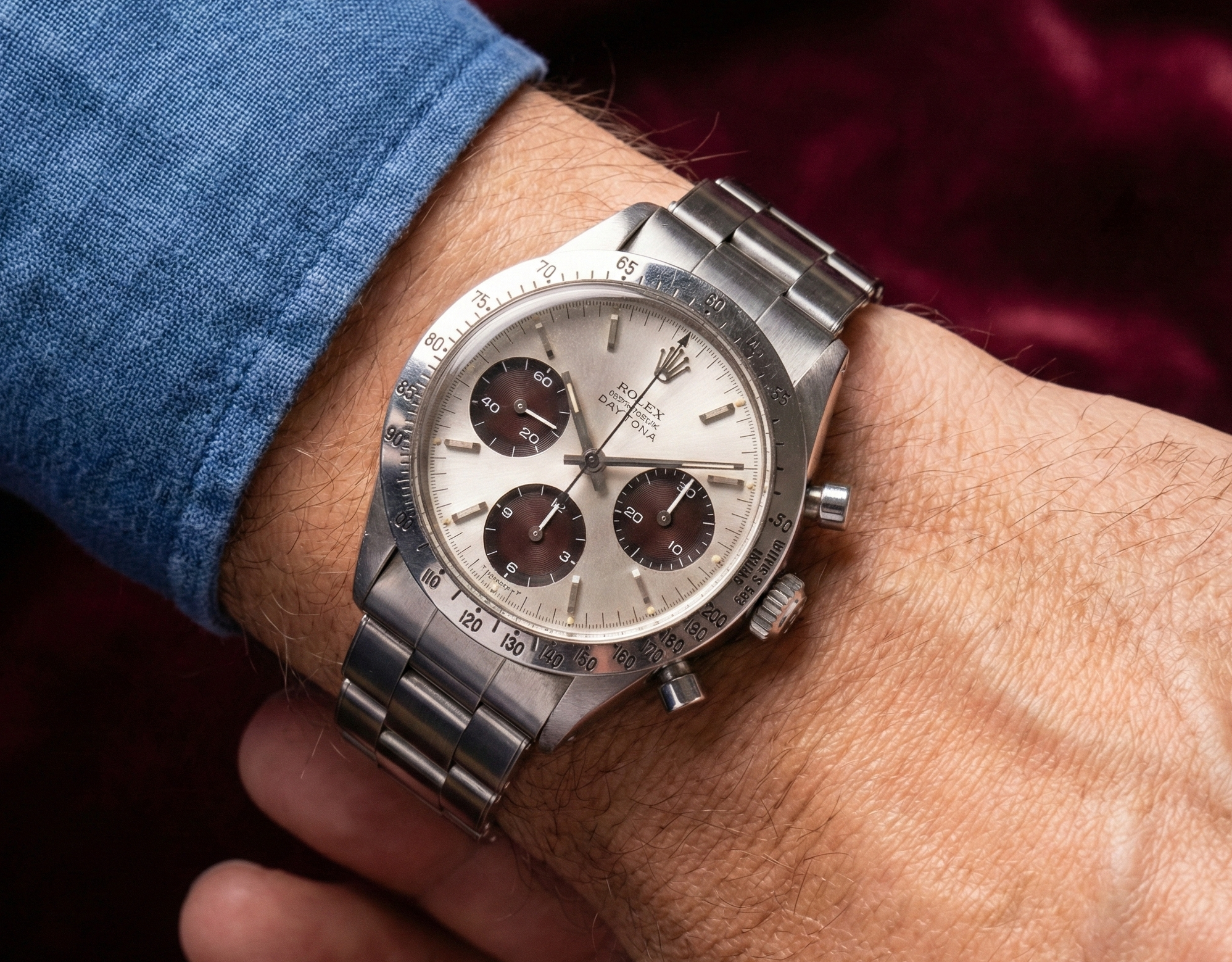


There are watches that simply tell time, and there are watches that feel like a freeze‑frame of an entire era. The Rolex Cosmograph Daytona ref. 6239 with “Jumbo” Daytona logo and tropical sub‑dials is very much the latter—a piece that looks as if it has soaked up decades of sunlight, gasoline, and whispered conversations in pit lanes and paddocks.

At first glance, it is almost understated: a slender 36 mm steel chronograph with a brushed silver dial, three chocolate‑toned registers, and a thin steel bezel engraved with a tachymeter scale. Look closer and the details start to hit you one by one—the oversized “Daytona” script arcing above the six o’clock register, the mocha‑brown color that has bloomed across the once‑black sub‑dials, the razor‑sharp pump pushers inviting you to start timing something, anything. It is a watch that feels both technical and emotional, like a vintage race car that still smells faintly of burnt rubber and adrenaline.
The story of the 6239 is, in many ways, the story of the modern Daytona itself. Launched in the early 1960s, the reference 6239 was the first Rolex chronograph to fully embrace the “Cosmograph” identity and the now‑iconic external tachymeter bezel. Instead of printing the scale around the dial, Rolex engraved it into a metal bezel to improve legibility at a glance—a crucial detail for drivers and track‑side timekeepers. The watch was offered in stainless steel and precious metals, with contrasting dials: silver with black registers or black with silver registers, all built around a compact, sharply profiled Oyster case that managed to look sporty without ever feeling aggressive.
The particular configuration that captures collectors’ hearts today is the silver dial with brown “tropical” registers and the so‑called Jumbo, or “Big Daytona,” logo. Produced for a narrow window in the mid‑1960s, and most famously around 1967, these dials feature a noticeably larger “Daytona” script printed above the lower sub‑dial instead of the smaller, more discreet lettering seen on other early references. On the wrist, that single design tweak completely changes the watch’s personality. It becomes bolder, more graphic, leaning into its racing identity without losing the clean symmetry that makes the 6239 such a timeless object.
Then there is the tropical effect. Originally, the sub‑registers on this variant were a deep, inky black. Over the years, a combination of UV exposure, humidity, and the natural aging of 1960s dial lacquers has transformed them into a rich palette of browns—from dark espresso at the center to a warmer, almost caramel tone toward the edges. No two tropical dials age exactly the same way; each one becomes a kind of fingerprint. For many collectors, that unpredictable, naturally “customized” patina is precisely what elevates a watch from rare to unforgettable.
Mechanically, the ref. 6239 is driven by a hand‑wound chronograph movement from the Valjoux 72 family, modified and finished by Rolex. It beats at a leisurely vintage pace, with crisp column‑wheel engagement and a kind of tactile honesty that modern automatic chronographs sometimes lack. Winding it every morning is a small ritual—ten, fifteen turns of the crown until you feel the mainspring tighten, the sense that you are waking the watch up before you step into your day. There is no rotor humming away invisibly; the power reserve depends on you, and that interaction makes you more aware of the time you are about to spend.
On the wrist, a 6239 with Jumbo logo and tropical registers feels surprisingly contemporary in its proportions. At 36 mm, it wears slim and elegant, but the broad steel bezel and high‑contrast sub‑dials give it real presence. The riveted Oyster bracelet adds just the right touch of vintage cool: light, articulate links that drape over the wrist rather than locking it in place, with that slightly hollow, nostalgic “rattle” that collectors secretly love. It is the kind of watch you can wear with a faded sweatshirt and denim in Tokyo one day, then with an unstructured blazer in Milan the next. It never feels out of place; it just changes context.
What makes this reference so addictive for today’s global community of collectors—from New York and London to Seoul, Shanghai, and Jakarta—is how layered it is. On one level, it is a pure design object: sunburst silver dial, concentric guilloché in the sub‑dials, clean baton markers, slim stick hands. On another level, it is loaded with subtext. This is the first generation of Daytona, the one that set the blueprint for everything that came after. It is linked, by bloodline if not by dial, to the mythical “Paul Newman” variants that reshaped the vintage market and turned the Daytona into a cultural phenomenon. It carries the romance of 1960s motorsport, when circuits were dangerous, helmets were minimal, and drivers were rock stars.
Condition, of course, is where the 6239 becomes a serious grown‑up conversation. Collectors obsess over the sharpness of the lugs, the integrity of the bezel engraving, the originality of the pump pushers, and the untouched, honest quality of the dial. A true tropical 6239 with Jumbo logo is not something you stumble upon on a random afternoon scroll; it is usually the result of years of hunting, networking, and waiting for the right piece to surface from a safe, an estate, or an old‑school dealer’s tray. The aging needs to feel organic, the lume plots warm and even, the printing clean and unretouched. When all of that aligns, the watch stops being just a reference number and becomes a story trapped under acrylic.

In 2026, the market for these pieces reflects that reality. Standard steel 6239s already command serious five‑ and six‑figure money depending on configuration and condition. Add a beautifully aged tropical dial and the oversized Daytona script, and you are in a different realm altogether—often flirting with or surpassing the high end of the vintage Daytona spectrum outside of the most famous Paul Newman and special‑provenance pieces. For collectors in their twenties and thirties building their first serious collection, this watch may sit squarely in “grail” territory, something to aim for rather than casually acquire. For more established collectors, it becomes a cornerstone—a piece that anchors a wider Daytona or chronograph lineup.
Yet despite the prices and the auction headlines, there is something disarmingly human about a 6239 like this. It is not flawless. The steel bezel often shows tiny dings from decades of real wear; the acrylic crystal may carry hairline scratches that catch the light just so; the tropical registers can be uneven, darker in some areas, lighter in others. But that is exactly the point. In a world of perfectly manufactured, algorithm‑approved objects, a watch that has aged unpredictably feels like a quiet rebellion. It reminds you that time leaves traces, and that those traces can be beautiful.
For enthusiasts across continents, from café meet‑ups in Paris and Tokyo to late‑night group chats in Hong Kong and Los Angeles, the Jumbo‑logo tropical 6239 is the kind of watch that sparks long conversations. Which brown tone do you prefer—deep tobacco or milk chocolate? Do you like your logo loud and proud or a little more discreet? Is a slightly soft case acceptable if the dial is out‑of‑this‑world? These are the debates that keep the community alive, bridging cultures and time zones through a shared obsession no smartphone can replace.
In the end, the Rolex Cosmograph Daytona ref. 6239 with Jumbo logo and tropical sub‑dials is more than a vintage chronograph. It is a mood, a piece of 1960s speed culture distilled into steel and sunburst silver. It balances restraint and drama in a way very few watches ever manage. If you are lucky enough to wear one, you do not just check the time—you feel connected to a different pace of life, a different soundtrack, a different kind of risk. And that feeling, once experienced, is almost impossible to forget.
| Rolex Cosmograph Daytona Ref. 6239 “Jumbo Logo” Tropical – Key Specs & 2026 Market View | Details |
|---|---|
| Brand | Rolex |
| Model | Cosmograph Daytona |
| Reference | 6239 |
| Production period | Circa 1963–1969, Jumbo logo and tropical sub‑dials typically mid‑1960s |
| Case material | Stainless steel |
| Case diameter | 36 mm |
| Bezel | Fixed stainless‑steel bezel engraved with tachymeter scale |
| Crystal | Acrylic (plexiglass) |
| Movement | Hand‑wound chronograph, Valjoux 72‑family calibre (e.g., 722/722‑1), column‑wheel |
| Functions | Hours, minutes, small seconds, 30‑minute and 12‑hour chronograph, tachymeter scale |
| Dial | Silver sunburst main dial with three contrasting dark‑to‑tobacco‑brown tropical sub‑dials |
| Logo configuration | “Jumbo” or “Big Daytona” script above the six o’clock register under “Cosmograph” text |
| Pushers | Pump‑style chronograph pushers, screw‑down crown |
| Bracelet | Riveted stainless‑steel Oyster bracelet with folding clasp |
| Original water resistance | Splash‑resistant sports chronograph; not intended for deep diving by modern standards |
| Approximate market price in 2026 | Roughly USD 250,000–450,000 for well‑preserved, fully correct Jumbo‑logo tropical examples; significantly lower for standard, non‑tropical or heavily restored pieces |


Leave a Reply