
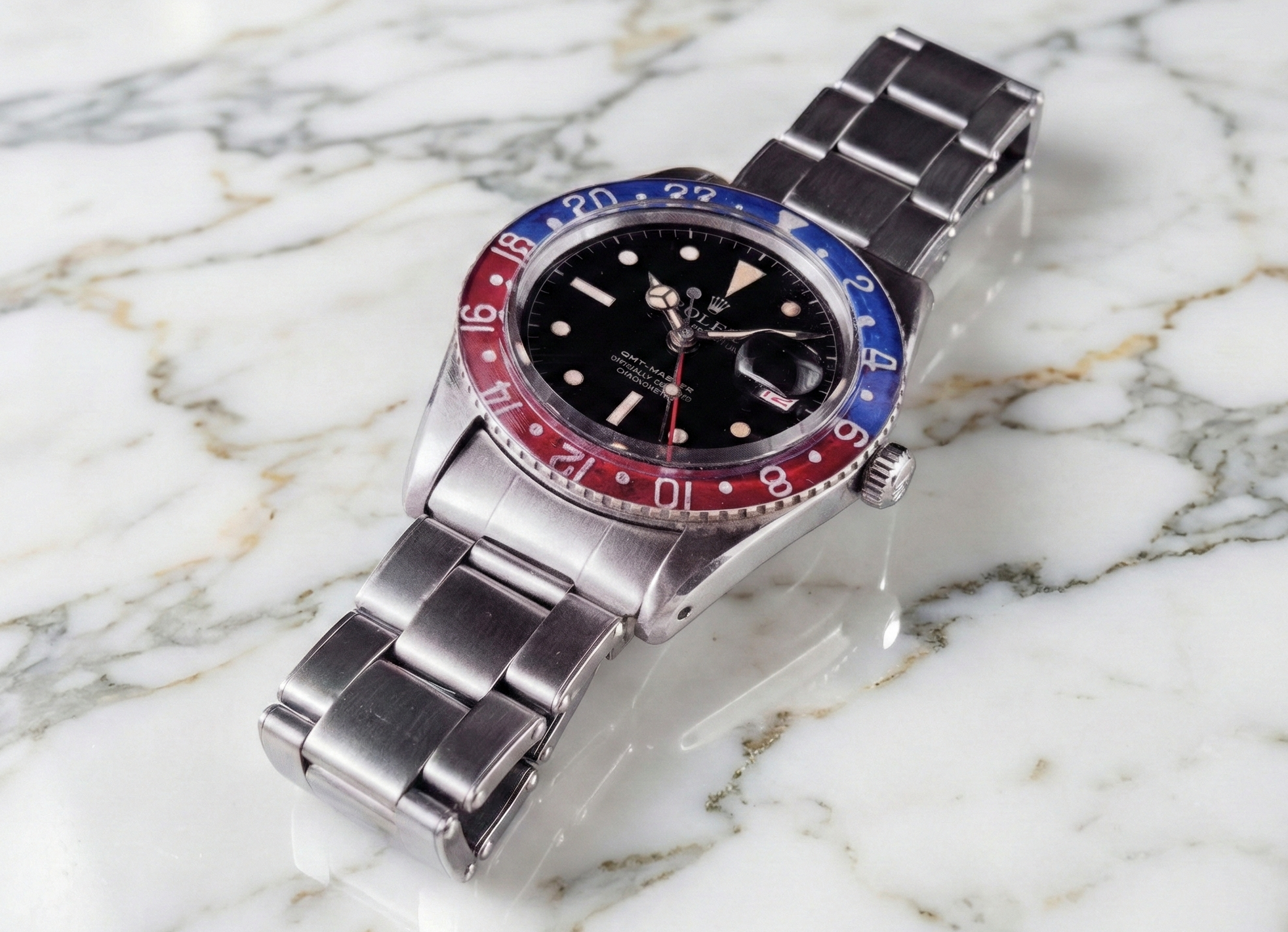


There are watches that quietly tick along history’s margins, and there are watches that rewrite the rules of modern travel. The Rolex GMT‑Master reference 6542 belongs firmly to the second group: a slim, shimmering bezel of translucent color, a glossy black dial glowing like a runway at dusk, and a story that still makes seasoned collectors feel a little weak in the knees.

For many enthusiasts, the journey into vintage Rolex begins with the Submariner. Yet if you talk to collectors who live half their lives on planes or obsess over mid‑century design, the watch that really haunts them is the original GMT‑Master, the ref. 6542. It is the watch of Pan Am captains and jet‑age glamour, of bakelite and radium, of gilt dials and bold red 24‑hour hands cutting across continents in a single sweep. It looks fragile, almost too pretty for hard travel, and that is exactly why it is so irresistible.
This reference did not appear out of thin air. In the early 1950s, as commercial aviation exploded and intercontinental flights became a symbol of post‑war optimism, Pan American World Airways approached Rolex with a very specific problem: their pilots were crossing time zones so quickly that tracking local and home time with standard three‑hand watches had become a headache. The brief was simple but ambitious—create a professional tool watch that could show two time zones, remain waterproof, and still carry the discreet elegance expected on a captain’s wrist in the first‑class cabin.
Rolex responded with something quietly radical. Instead of cluttering the dial with extra sub‑registers, they added a fourth hand geared to make one full rotation every 24 hours and paired it with a bidirectional bezel printed with a 24‑hour scale. The result was the GMT‑Master ref. 6542, introduced around 1954, a stainless‑steel sports watch that looked like nothing else on the market. The bezel was the real show‑stopper: a translucent bakelite insert with luminous numerals suspended under the surface, half in rich blue for the night hours, half in deep red for the daylight hours. Under the bright cabin lights of Pan Am’s Boeing 707s, it must have looked like a tiny piece of neon architecture strapped to the wrist.
Part of the magic of the 6542 is precisely how uncompromising it feels. At 38 mm, with no crown guards and slender lugs, it wears closer to a dressy sports watch than a modern tool monster. The case lines are soft yet purposeful, a reminder that this was built for long‑haul flights rather than saturation diving. Early examples carried gilt‑print black lacquer dials, where the text seems to float above the surface under the domed acrylic crystal. Paired with creamy radium plots and a slender red GMT hand tipped with a small triangle, the overall composition is pure mid‑century cool.
Then there is the bezel, the detail that turned a clever piece of engineering into design legend. Bakelite—an early plastic—was chosen because it allowed Rolex to embed luminous material under a clear, glossy surface, reducing reflections while making the numerals shine through like tiny light boxes. In theory, it was perfect for pilots needing to track time in low‑light conditions without blinding glare. In practice, bakelite proved brittle and vulnerable to cracking and discoloration, especially when exposed to shocks, UV light, or sudden temperature changes. That fragility, coupled with later safety concerns around the radium‑charged numerals, meant many bezels were replaced with later aluminum inserts during servicing. Today, a well‑preserved original bakelite bezel is almost a unicorn—its swirl of raspberry red and faded denim blue, the tiny chips and ghosted numerals, telling a story of decades spent in the real world.
Inside, the 6542 was powered by Rolex’s early GMT calibres, evolutions of their robust automatic movements of the era, modified to drive the additional 24‑hour hand. These movements were never designed for quick‑set convenience. Instead, you read them the way pilots did: set the 24‑hour hand to Greenwich Mean Time or home time, rotate the bezel to align with the current time zone, and let the watch quietly take care of the math while you navigated between continents and hotel lobbies. There is something beautifully analog about this process, especially in a world where smartphones scream out multiple time zones in digital neon. With the GMT‑Master 6542, you feel like you are participating in a subtle ritual, aligning your day to the rhythms of the planet.
What keeps this reference so compelling for today’s collectors is not just its provenance or rarity, but its aesthetic tension. On the one hand, it is a pure tool—dual‑time function, luminous markers, Oyster bracelet, screw‑down crown, chronometer‑rated movement. On the other hand, it looks like a piece of jewelry: the lacquer dial catching light like piano black, the bezel colors bleeding into each other as they age, the slender case slipping under a cuff with ease. It is the polar opposite of a “look at me” modern travel watch; it whispers rather than shouts, yet anyone who knows watches will spot it from across the room.

Condition, of course, is where the 6542 becomes a serious game. Originality is everything. Collectors hunt for unpolished or lightly polished cases with strong chamfers, untouched dials with even radium patina, and—if fortune smiles—a correct period bakelite insert with its characteristic glossy depth. Many examples on the market today show replacement parts from later service cycles, which is understandable given the watch’s working life but heavily influences value. The example shown here, with its warm pumpkin‑toned lume, crisp gilt printing, and fiercely charismatic bezel, represents exactly the kind of “honest” watch that makes seasoned connoisseurs lean in a little closer.
Wearing a vintage 6542 in 2026 is a statement that goes far beyond flex culture or hype cycles. It is choosing to live with a fragile artifact in a world obsessed with indestructible gear. You accept that the bezel might be vulnerable, that the watch deserves careful handling, that it is more vintage sports car than daily commuter. But that vulnerability is part of its allure. When you catch the light glancing off the curved acrylic crystal and the bezel’s translucent surface, you are reminded that beauty often comes with edges, and that the early jet age was as much about romance as it was about speed.
From a market perspective, the 6542 has moved firmly into the realm of serious collector’s piece. Blue‑chip auction houses have highlighted standout examples, and prices for original, correct watches have climbed accordingly. Yet even as values rise, what fascinates many enthusiasts is how contemporary the design still feels. Put a 6542 next to a modern GMT‑Master and you immediately see the DNA—Pepsi bezel, four‑hand layout, Oyster case—but also the subtle differences: the older watch is slimmer, softer, a touch more poetic. It is like comparing an early transatlantic prop‑liner to a current‑generation jet: the technology has advanced, but the original carries a spirit that later iterations can only echo.
For younger collectors from Tokyo to Jakarta, New York to Berlin, this watch has become something of a grail—not because it is loud, but because it is deeply narrative. It ties you to the first golden age of air travel, to Pan Am crews walking through terminals in tailored uniforms, to a time when crossing the Atlantic felt like stepping into science fiction. In a culture saturated with instant drops and algorithm‑driven trends, the GMT‑Master 6542 is refreshingly analog. It is a slow burn. You learn its history, study the tiny variations in dials and bezels, trade late‑night messages with other obsessives in Seoul or Milan, and maybe, just maybe, one day you find an example that feels right.
In the end, that is what makes the Rolex GMT‑Master ref. 6542 more than a collectible. It is a companion for people who are curious about the world, who read departure boards like poetry, who love the idea that a flick of the wrist can take you from home time to somewhere half a planet away. It may be fragile, it may be rare, and it may be well beyond the reach of most budgets—but its influence is everywhere, from modern travel watches to the way we think about time zones in daily life. The jet age might have given us speed and convenience, but this watch gave us something else: a beautifully human way to navigate time itself.
| Rolex GMT‑Master Ref. 6542 – Key Specifications (2026) | Details |
|---|---|
| Brand | Rolex |
| Model | GMT‑Master |
| Reference | 6542 |
| Year of production (example shown) | Late 1950s |
| Case material | Stainless steel |
| Case diameter | 38 mm |
| Crystal | Acrylic (plexiglass) |
| Bezel | Bidirectional 24‑hour bezel with red/blue bakelite insert |
| Dial | Black lacquer gilt dial with radium luminous hour markers |
| Hands | Mercedes hour hand, pencil minute hand, red 24‑hour hand with triangle tip, central seconds |
| Movement type | Automatic, chronometer‑rated GMT movement with 24‑hour hand |
| Functions | Hours, minutes, central seconds, dual time (24‑hour hand with rotating bezel) |
| Water resistance (original rating) | 50–100 m class, suitable for everyday wear rather than deep diving |
| Bracelet | Stainless‑steel Rolex Oyster bracelet with folding clasp |
| Lug width | Approximately 20 mm |
| Approximate market value in 2026 | Around USD 250,000–400,000 for well‑preserved, correct examples with original bakelite bezel; significantly less for heavily serviced or replaced parts |


Leave a Reply