
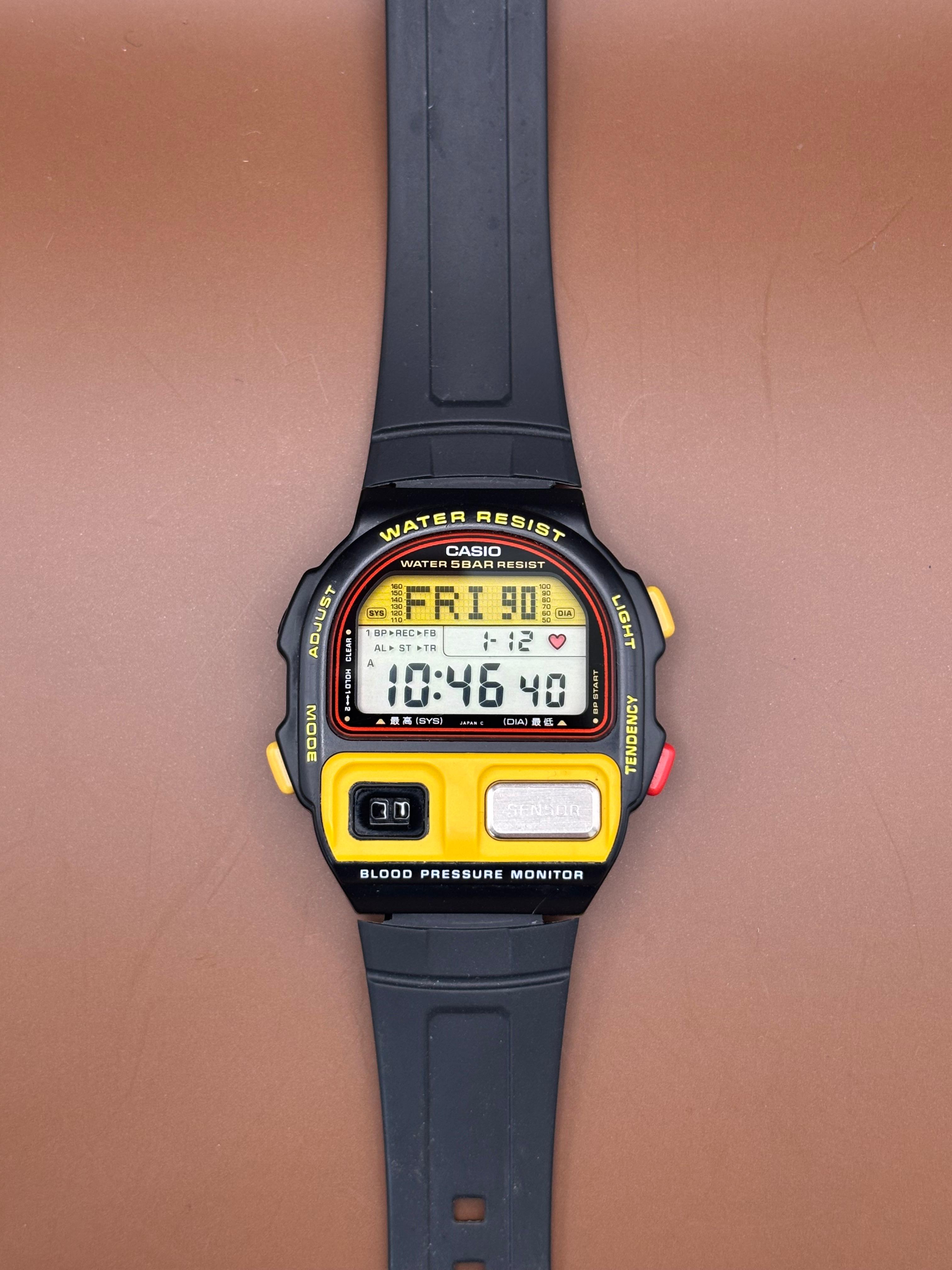


It’s easy to forget that “wearables” didn’t begin with glass screens and app notifications. Long before wrist-based wellness became a lifestyle, Casio built something boldly strange and oddly charming: a digital watch that could measure blood pressure and display pulse data like a pocket-sized medical gadget from a futuristic clinic. The BP-100 is the kind of object that makes you smile first, then spiral into respect—because it was decades ahead of the curve.
If you’re collecting vintage watches in 2026, the BP-100 sits in a new kind of grail category: not precious-metal rarities, but tech artifacts with real cultural gravity. It’s part sports watch, part early health monitor, part design statement—exactly the kind of “retro-futurism” people are styling with everything from clean tailoring to streetwear. And unlike many trend pieces, the BP-100 doesn’t feel like an imitation of the past; it is the past that got it right.
Interested to Buy this Casio BP-100? Order 1 remaining piece here

The keyword palette matters here because the BP-100 is usually discovered through the same search phrases over and over: “blood pressure monitor watch,” “pulse,” “optical sensor,” “ECG signals,” “graph display,” “touch sensor,” “memory,” and—always—“BP-100.” Those are the words that show up across the most visited pages about this model, because they describe what makes it collectible: it’s not just a vintage Casio, it’s a health-tech landmark you can wear.
The origin story is genuinely iconic. Casio’s own heritage timeline describes the BP-100 (dated to 1992) as the world’s first watch with an optical blood pressure monitor, designed to calculate blood pressure by analyzing changes in blood flow (optical sensor) alongside ECG signals. It also notes that you can get a reading simply by touching a fingertip to the sensor—no arm cuff, no squeezing—an idea that sounds normal now and sounded like science fiction then.
The mechanics behind the magic are nerdy in the best way. A classic deep-dive from the vintage LCD community explains that the BP-100 uses a combination of sensor technologies and includes ECG probe leads built into the watch—one of which is on the backplate—so proper skin contact on the wrist matters for the system to work. That same source points out that you’re meant to touch the sensors with your right hand while keeping the watch seated correctly, because accidental contact paths can interfere with the reading.

And yes, the BP-100 doesn’t just take measurements—it remembers them. Casio’s heritage page states it stored up to 30 datapoints in memory (including pulse), and the enthusiast write-up echoes the idea of stored readings with timestamps plus a graph-style view of past measurements. This is where the BP-100 stops being a quirky Casio and starts feeling like a proto-smartwatch: memory, trend visualization, and health metrics—done with early-90s constraints and confidence.

Design-wise, the BP-100 is pure Casio bravado. The display is dense, layered, and frankly unapologetic—because that’s what real tool design looks like when function leads the dance. The bezel text on many units calls out water resistance, and the watch body frames the screen like a piece of rugged equipment rather than jewelry. In your photos, the case is bold, with playful color blocking—black and yellow in one version, and white with blue accents in another—making it feel almost “techcore” before techcore had a name.
Daily-wear practicality is part of its charm. A technical-data style page about the BP-100 highlights health functions like blood pressure measurement and pulse sensing, alongside everyday utility features commonly associated with Casio digitals (alarms, and other standard modes depending on module). Meanwhile, the enthusiast review emphasizes that beyond the health functions, it’s still a Casio at heart: it has a microlight and classic timing modes like alarm, stopwatch, and timer.
Now for the most important reality check: the BP-100 is a vintage collectible, not a modern medical device. Even sellers and owners who confirm that the health features “work” often can’t guarantee accuracy by clinical standards, and usage is sensitive to fit and skin contact. If you’re wearing it today, think of the blood-pressure function as a fascinating historical feature—like owning a vintage camera that still shoots, even if you wouldn’t use it for a professional assignment.
So who is the BP-100 for in 2026?
It’s for the collector who’s bored of predictable. It’s for the person who likes vintage Casio because it’s honest—plastic and metal and circuitry with nothing to prove. It’s for anyone who enjoys that “IYKYK” moment when someone recognizes what you’re wearing and realizes it’s not just another digital watch. And stylistically, it’s a dream for people who lean into minimal outfits: the BP-100 becomes the one statement detail that feels intentional, not loud.
Occasion-wise, it’s surprisingly versatile—just not in the traditional dress-watch way. The BP-100 is best for casual to smart-casual settings: travel days, coffee runs, creative work, city weekends, and anywhere you want an accessory that feels like a conversation starter. It also fits certain modern aesthetics perfectly: gorpcore, clean sportswear, vintage Japanese street style, and even “quiet luxury” outfits that need a single eccentric punctuation mark.
Collecting tips are straightforward, but they matter more than people expect:
- Sensor condition matters more than cosmetics. A BP-100 with perfect case color but unreliable sensor behavior is less satisfying than a scuffed one that consistently reads and stores data.
- Strap originality is a bonus, not a requirement. Many surviving examples have aftermarket straps, and that’s fine—just factor it into price and authenticity expectations.
- Light and beep functions are part of the charm. Vintage digitals often have dimmer lights with age, and it’s worth checking if the microlight and alarms still behave as expected.
- Completeness changes everything. Boxes, manuals, and accessories can push values up sharply because this model lives at the crossroads of watch collecting and tech collecting.

Market pricing in 2026 is best described as “wide.” You’ll see plain, working examples offered around the low hundreds, while cleaner pieces (especially with box and full set) can climb significantly. One retailer-style listing shows the BP-100 offered at $200 with shipping included, positioned as a Japan vintage piece. Etsy listings and similar marketplaces show higher asking prices for rarer, boxed examples—one example is listed around $292 for a “Vintage Casio BP-100 Blood Pressure Monitor Made in Japan 1990s” with tin box positioning. In other words: the BP-100 is not priced like a basic F-91W; it’s priced like a niche icon.
The reason it holds attention is simple: it’s historically meaningful and visually fun. Casio’s own write-up frames it as a groundbreaker that delivered health-oriented functionality “decades ahead of its time,” which is exactly how it feels on the wrist today. In a world of polished smartwatches that all look vaguely the same, a BP-100 looks like a deliberate choice—almost rebellious in its sincerity.
Table: Specifications & 2026 Market Estimate


Leave a Reply