
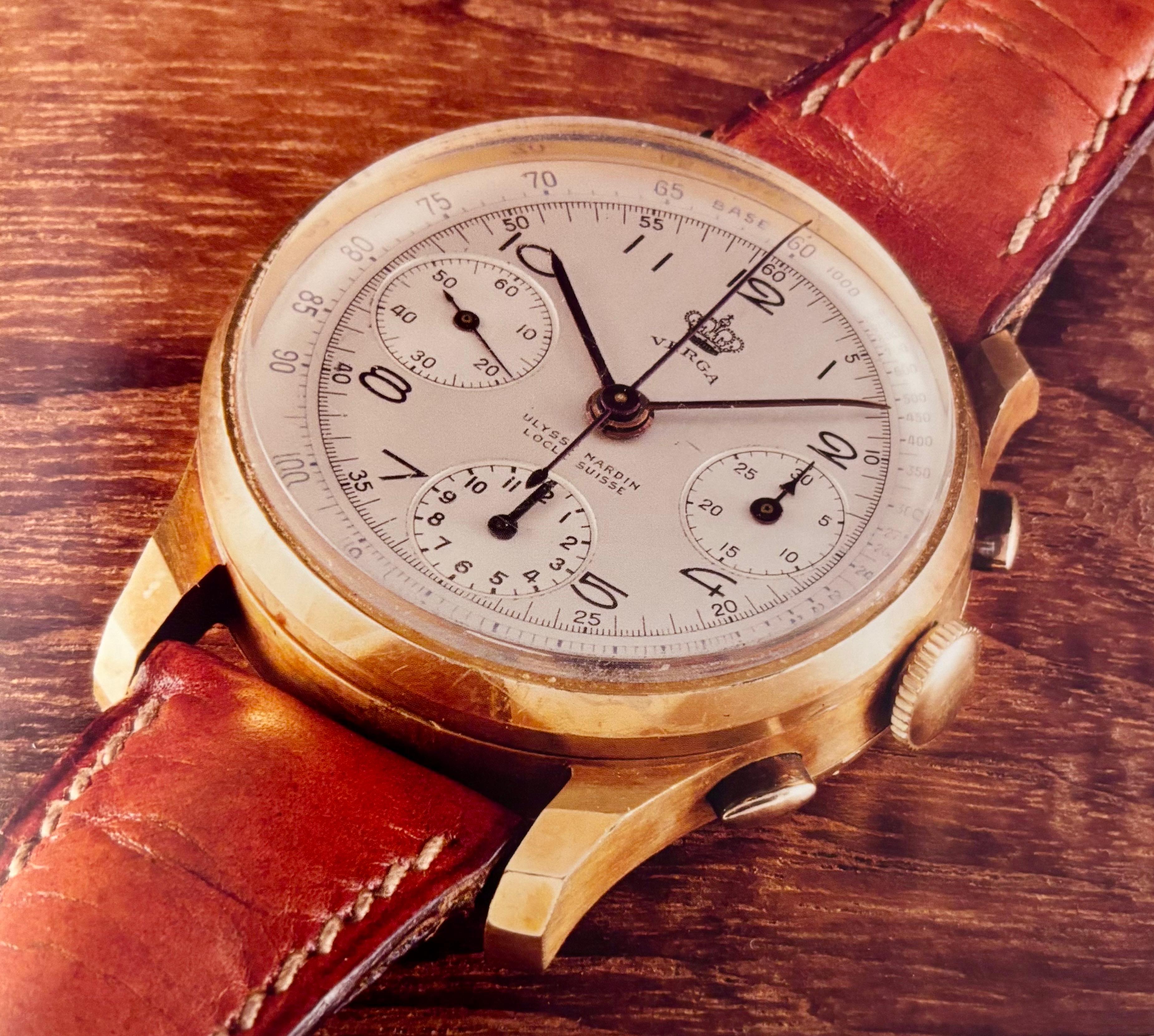


Some watches look like they were designed; others look like they were discovered. This Ulysse Nardin chronograph—presented as Lot 215, no reserve—has that rare “discovered” energy: a warm gold case with sharp, triple‑faceted lugs, a generous mid‑century diameter, and a dial layout that feels both elegant and intensely functional. It’s the kind of piece you imagine being pulled from a dresser drawer in an old apartment in Rome, still smelling faintly of leather, paper, and sunlight.

At first glance, it’s a classic two‑register chronograph. Then the details start to stack up: the long, sculptural lugs that catch light like architecture; the stepped scales that make the dial feel like an instrument panel; the slightly whimsical, almost calligraphic numerals that give it personality without sacrificing legibility. Add the fact that the catalogue text hints at a special‑order dial—possibly linked to a retailer in Rome—and you’re looking at something that sits comfortably in the “collector’s watch” category rather than the “nice vintage” category.
Ulysse Nardin is often discussed through the lens of marine chronometers and navigation, and that heritage matters here. The brand’s identity has always been connected to precision, measurement, and professional timing—tools for people who needed dependable instruments long before timekeeping became lifestyle content. A chronograph like this feels like a natural extension of that DNA, but wrapped in a softer, more cosmopolitan suit: gold case, elegant dial, and proportions that were ahead of their time.
What makes this piece particularly seductive is its sense of scale. The catalogue copy notes a diameter of over 35 mm—big for the era, and still wonderfully wearable in 2026. “Large for its time” is usually marketing fluff; here it’s a real design advantage. It means the dial can breathe. The registers sit comfortably, the scales are easier to read, and the whole watch has presence without resorting to modern bulk. You put it on and it doesn’t feel like a delicate antique; it feels like a confident vintage chronograph that simply happens to be old.
Now, let’s talk about those lugs. Triple‑faceted lugs sound like a small detail until you see how they change the character of the case. Instead of a simple curve, each lug breaks into planes, catching light differently as your wrist moves. It’s subtle, but it’s exactly the sort of detail that separates “standard” from “special.” In photos, it adds depth; in real life, it adds charisma. This is one of those watches that will look different every time you glance down, especially in late‑afternoon light when gold turns softer and richer.
The dial leans into function, but it does so with style. You’ve got a clean two‑register layout, balanced and legible, with multiple scales that hint at a world where timing mattered: telemeter for distance measured by sound, tachymeter for speed. The fonts are beautifully period—slightly playful, slightly serious—giving the watch a personality that feels human rather than sterile. And because the watch is described as being preserved with its original crystal, you get that warm vintage distortion at the edges, the little optical softness that makes old watches feel cinematic rather than clinical.

There’s also a certain romance in the suggestion of a retailer signature below the center. In the mid‑century world, retailer‑signed dials were a quiet status signal. They told you where the watch came from, who sold it, and sometimes who it was intended for. If this was indeed tied to Rome, it adds a layer of cultural texture: the idea of a chronograph commissioned with a touch of local identity, made to stand apart from the standard catalogue offering. It becomes less “a Ulysse Nardin” and more “this Ulysse Nardin,” with a story that can’t be mass‑produced.
On the wrist, the vibe is effortless old‑money—without the modern cliché. Gold chronographs can sometimes feel flashy; this one doesn’t. The warmth of the case is balanced by the pale dial and the aged, honest tones of the strap. It reads as mature, not loud. It’s a watch that looks right with a linen shirt and loafers in summer, and just as right with a dark knit and tailored trousers in winter. In cities like Tokyo, it feels like a curated object. In London or New York, it feels like inherited taste. In Dubai or Riyadh, it feels luxurious but not performative. In Southeast Asia, it’s the kind of piece that stands out because it’s not what everyone else is wearing.
Who suits this watch? Someone who likes their luxury to be slightly nerdy. A collector who actually uses a chronograph—timing a drive, a coffee extraction, a workout interval, a flight delay—because that’s the point of owning one. It also suits the person who’s tired of brand‑new perfection and wants something with texture: soft patina, crisp edges where it counts, and the gentle lived‑in mood that makes vintage so addictive.
Occasion-wise, this is surprisingly flexible. It’s excellent for dinners, events, and weddings because it’s gold and elegant—but it’s also a great “everyday special” watch if your lifestyle is calm and you enjoy dressing well. It’s not a beach watch, not a gym watch, and it doesn’t pretend to be. But for office days, creative work, travel, and evenings out, it’s a killer choice—especially because it doesn’t look like the obvious modern status symbols. It looks like you found something.
And then there’s the market reality in 2026. Your images show this presented as “no reserve,” which tends to spark attention because it creates a sense of opportunity—especially when the object is genuinely rare. The catalogue text also frames it as one of the best market examples to come up in recent years, with a very well‑preserved and unpolished condition. Watches like this don’t just trade on brand name; they trade on scarcity, condition, and that hard‑to‑define quality collectors call “rightness.”
When you approach a watch like this, you want to keep your head and your heart in balance. The heart will fall for the lugs, the dial, the story. The head should check the fundamentals: originality, movement health, dial integrity, and case sharpness. If those boxes are ticked, you’re looking at the kind of chronograph that tends to stay relevant even when trends swing wildly—because it’s not trend‑driven in the first place.
If you’re hunting in this category, it helps to take a “vintage watches specification” approach—study the case geometry, the dial printing style, the scale layout, the pusher shapes, and the way the hands match the era. This isn’t about gatekeeping; it’s about protecting yourself and appreciating why one example becomes a grail while another remains a nice curiosity.
The reason pieces like this endure is simple: they feel personal. A modern chronograph can be perfect and still feel generic, because it’s designed for everyone. A mid‑century Ulysse Nardin chronograph with faceted lugs and a likely special‑order dial feels like it was designed for someone specific—and somehow it found its way to you.
In the end, this watch offers a particular kind of luxury: the luxury of being slightly off the main road. It’s not the watch everyone recognizes, and that’s the advantage. It’s a rare, handsome gold chronograph with enough design nuance to keep you interested for years—and enough presence to make you look like you know exactly what you’re doing, even if you’re just timing pasta.
Table: Specifications & 2026 Market Estimate (Based on the Attached Lot Page)
| Specification | Details |
|---|---|
| Manufacturer | Ulysse Nardin |
| Lot | Lot 215 (No Reserve) |
| Type | Vintage chronograph wristwatch |
| Case material | Yellow gold (as described on the lot page) |
| Case style highlight | Triple‑faceted lugs; large case for the era (over 35 mm noted in text) |
| Dial | Multi‑scale chronograph dial, described as likely special‑order; retailer signature possibly positioned below center (per lot text) |
| Registers | Two registers (bi‑compax layout) |
| Crystal | Original crystal noted in text |
| Strap | Leather strap (noted) |
| Buckle | Gold buckle (noted) |
| Condition notes (lot text) | Virtually unworn / very well preserved; unpolished condition mentioned |
| Estimate shown | Not visible on the provided photo crop (the page shown focuses on description and imagery) |
| Inflation‑adjusted 2026 equivalent | Not calculable from the provided crop because the estimate values are not shown |
| Practical 2026 market expectation | High variability; rare gold Ulysse Nardin chronographs with special dials and strong condition often trade in the USD 25,000–90,000+ range depending on originality, provenance, and movement type |


Leave a Reply